You’ve taken the test drive. You ran your hands along the body panels, listened for knocking under the hood, and verified that the cold A/C isn’t just blowing wishful thinking. The car drives great. Your brain is already parking it in your driveway.
This is the moment you are most vulnerable.
I’ve been there. Back in 2008, I was so excited about getting the keys to a clean-looking 2003 Dodge Intrepid that I practically signed the paperwork with my eyes closed. Three days later, I realized the seller had slipped in a "Total Loss/Salvage" line item on the bill of sale that I completely glossed over in my hurry to drive home. That mistake cost me $4,000 and months of headaches.
When you sit down at the closing table—whether that’s a shiny desk in a dealership back room or the hood of a car in a Target parking lot—the emotional part of your brain needs to turn off. The detective part needs to take over.
Before you hand over your hard-earned cash or sign your name on that dotted line, run through these 8 non-negotiable checks.
1. Physical VIN Matching (All 3 Spots)
Don't just read the VIN off the registration card or the ad. Walk over to the car with the paperwork in hand and physically match all 17 characters in at least three places:
The dashboard plate (visible through the bottom corner of the driver's windshield).
The driver’s side door jamb sticker/plate.
The title document and bill of sale right in front of you.
Why it matters: A simple typo on a title can block you from registering the car at the DMV for weeks. Worse, mismatched VINs on the car itself can mean you're looking at a stolen vehicle or a car welded together from two different wrecks.
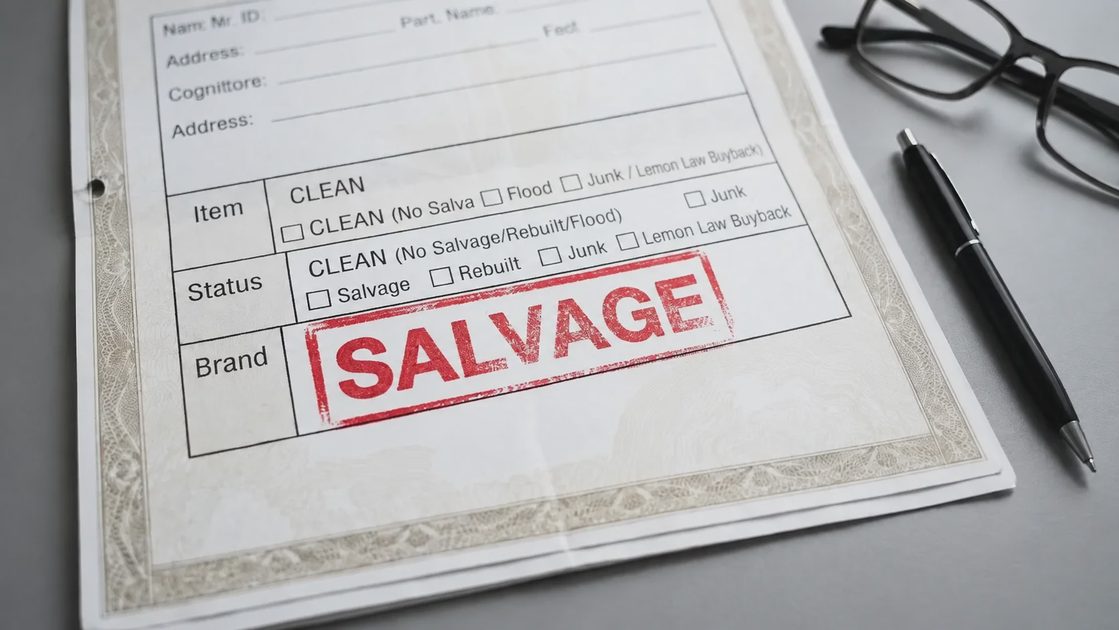
2. Title Brand Verification (Look for the "Scarlet Letters")
Grab the physical title document and scan for the word "BRANDED." You are looking for words like Salvage, Rebuilt, Flood, Junk, or Lemon Law Buyback.
If the seller promised a "clean title," but the paper says "Rebuilt," stop.
In some states, the title brand box is small or printed in faint text. Look carefully near the top header or under the vehicle specs.
Ray's Rule: Buy the car, not the story. If the seller says, "Oh, it was marked salvage just for a minor dent in 2018," it doesn't matter. A branded title shreds the car's resale value and makes insurance a nightmare.
3. The Lienholder Clearance
If you are buying from a private seller, check line 1 or the "Lienholder" section on the title.
If there is a bank or finance company listed, the seller does not legally own the car outright yet.
Ensure there is an official lien release stamp/letter from the bank or that the lender is present to execute the payoff at the time of sale.
Never hand cash to a private seller who promises to "pay off the bank and mail you the title later." You will likely never see that title—or your money—again.
4. Odometer Reading vs. Current Dash Reading
Look at the mileage listed on the Title Transfer / Bill of Sale section, then look at the car's gauge cluster.
The number on the dash should be equal to or slightly higher (from test drives) than the number written on the title.
If the title says 145,000 miles but the dash says 112,000, walk away immediately. Odometer rollback or gauge cluster swaps are more common than you think.
5. The "As-Is" Disclosure & Warranty Terms
If you are buying from a dealer or private party, look for the Buyer's Guide (the window sticker form) or the explicit condition terms on the Bill of Sale.
"As-Is - No Dealer Warranty" means exactly what it sounds like. The moment your back tires leave the lot, any repair—even if the engine explodes 5 minutes later—is 100% your financial responsibility.
If the seller verbally promised to fix something (e.g., "Bring it back Tuesday and we'll fix that squeaky belt"), get it in writing on the contract (often called a "We-Owe" sheet). If it’s not in writing, it doesn't exist.
6. Out-of-Pocket Hidden Fees (Dealerships Only)
If you're buying from an independent or franchise lot, carefully review the itemized breakdown before signing the total document. Watch out for added "junk fees" snuck in at the last second:
Document Fees (Doc Fees) exceeding state averages.
Dealer Prep Fees / Reconditioning Fees ($500–$1,500 sneaky add-ons).
Etching, Nitrogen Fill, or Fabric Protection add-ons you didn't ask for.
How to handle it: Tell them calmly, "I agreed to the out-of-the-door price of $X. Please remove these add-on fees, or I won't be able to sign today."
7. Valid ID & Seller Matching
When buying privately, ask to see the seller’s driver’s license and compare it directly to the name printed on the front of the title.
If the seller's name is John Smith, but the title says Mary Johnson, you are dealing with a "title skipper" (someone flipping cars without registering them to avoid paying taxes).
The Danger: If Mary Johnson didn't sign the transfer properly—or if the car was stolen—you won't be able to legally register it under your name.
8. Smog / Emissions / Inspection Certification
Depending on where you live (here in California, it's mandatory), the seller is often legally required to provide proof of a recent smog/emissions test pass before or at the time of sale.
Never accept a seller's promise of: "It'll pass smog easy, it just needs a cheap sensor." * If it was a cheap sensor, they would have replaced it themselves to sell the car faster. If it fails, a catalytic converter or emissions repair can easily cost $1,000 to $2,500.
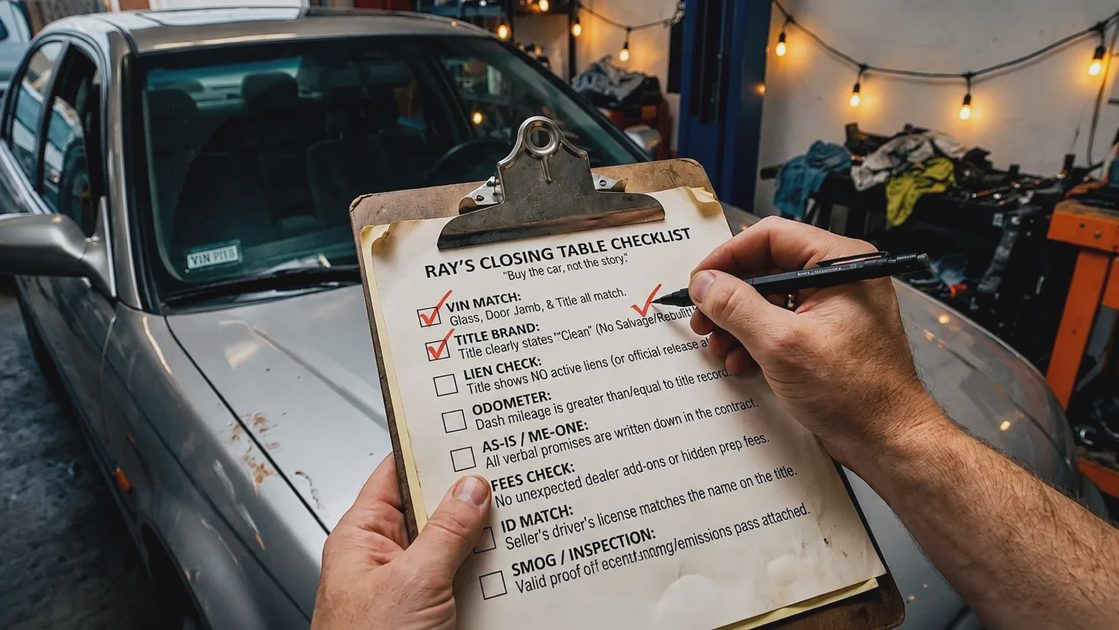
Keep This in Your Pocket: The Closing Table Checklist
Take a screenshot of this section before heading out to meet the seller!
RAY'S CLOSING TABLE CHECKLIST(Car lot Truth.com)
1. VIN MATCH: Glass, Door Jamb, & Title all match.
2. TITLE BRAND: Title clearly states "Clean" (No Salvage/Rebuilt/Flood).
3. LIEN CHECK: Title shows NO active liens (or official release attached).
4. ODOMETER: Dash mileage is greater than/equal to title record.
5. AS-IS / WE-OWE: All verbal promises are written down in the contract.
6. FEES CHECK: No unexpected dealer add-ons or hidden prep fees.
7. ID MATCH: Seller's driver's license matches the name on the title.
8. SMOG / INSPECTION: Valid proof of recent smog/emissions pass attache
Final Thought
Taking an extra 10 minutes at the desk or on the hood of the car to verify these eight points might feel awkward, but awkwardness fades in minutes. The cost of a bad title or an undisclosed lien lasts for years. Take your time, don't let anyone rush your pen, and if something feels off—walk. There are always other cars.
Buy the car,not the story.


