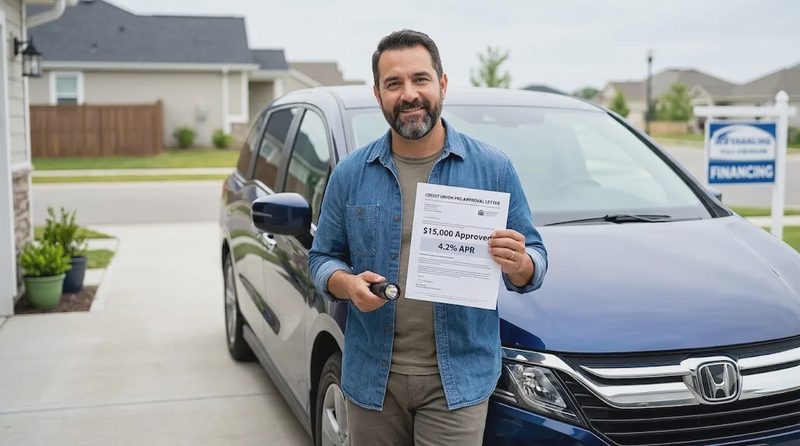
The finance manager at the dealership was named Kevin, and he had the most soothing voice I’ve ever heard on a man trying to take my money.
It was 2011. I was sitting in a windowless interior office, staring at a modern sedan I couldn’t quite afford, feeling that familiar mix of exhaustion and excitement that every used car lot produces. I had already spent three hours negotiating the price down to $12,400. I thought the hard part was over.
Then Kevin leaned back, clicked his pen, and smiled.
"Ray," he said, "great news. We got you approved. $285 a month. That’s less than ten bucks a day. You won't even feel it."
What Kevin didn't emphasize—and what I didn't catch because my brain was fried—was that he had stretched the loan out to 72 months, slipped in a $1,200 gap insurance policy I didn't ask for, and locked me in at an interest rate almost 4% higher than what my own credit union would have offered.
By the time that loan was paid off, I had handed that dealership nearly $4,000 in unnecessary interest and fees.
That was car number six for me. It was also the last time I ever financed a used vehicle through a dealer’s finance department.
Here is why dealer financing on a used car is almost always a trap—and how you should handle the money side instead.

1. The F&I Office Is Where Dealerships Make Their Real Money
Most people think dealerships make their profit by buying a car cheap and selling it for more. On new cars, margins are razor-thin. On used cars, there’s more room, but the biggest profit center on the entire lot isn’t the showroom floor.
It’s the F&I (Finance and Insurance) office.
When you sit down in that office, the sales process hasn't ended; it has just entered the high-margin phase. Finance managers aren't there to process paperwork as a courtesy to you. They are commissioned salespeople whose primary job is to sell you money and add-ons.
They do this in two ways:
Interest Rate Markup (Yield Spread Premium): The dealer acts as a broker. They send your credit profile to multiple lenders. Bank A approves you for a 5.5% interest rate. The dealer comes back to you and says, "Great news, we got you approved at 7.5%!" They pocket the difference as a kickback from the lender. On a $15,000 loan, that 2% markup costs you well over $800.
Backend Add-ons: Extended warranties, tire-and-wheel protection, paint sealant, gap insurance, and key replacement plans. These are routinely marked up 200% to 300% over their actual cost.
If you don't bring your own financing, you are walking into their office completely unarmed.
2. The "Monthly Payment" Illusion
Dealer finance managers love to talk in terms of monthly payments, not total cost.
"What if I could get you into this car for $250 a month?"
It sounds reasonable. But to hit that $250 target, they quietly stretch your loan term from 48 months to 72 or even 84 months.
On a new car under warranty, a long loan is risky. On a used car, a 6-year loan is financial disaster.
If you finance an 8-year-old Toyota for six years, you will be paying off the loan long after major repairs start stacking up. You end up underwater—meaning you owe more on the loan than the car is worth on the market. If the transmission drops in year three, you’re stuck paying a $3,000 repair bill on a car you can’t sell because you owe $8,000 on a loan for a car worth $5,000.
3. The Pre-Approval Shield: Bring Your Own Money
When I went to buy our family's Honda Odyssey a few years ago, the process looked completely different.
Two days before I set foot on a lot, I logged onto my local Credit Union website. I submitted my financial information, and within two hours I had a pre-approval letter for up to $18,000 at a fixed 4.2% APR for 48 months.
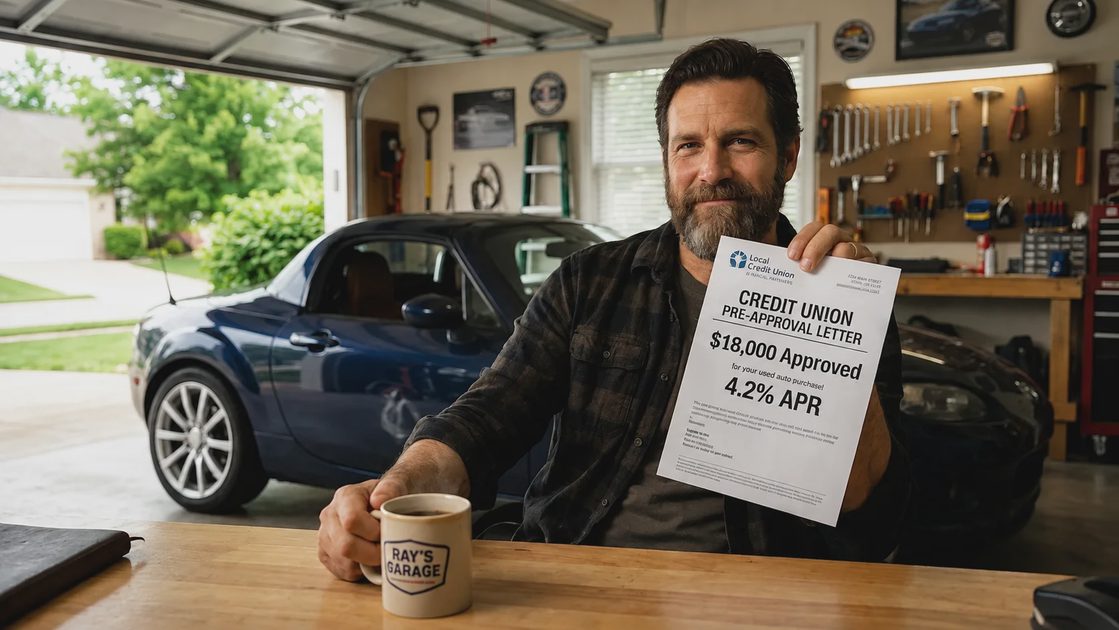
When you walk onto a car lot with a pre-approval letter from your own credit union or bank, three magic things happen:
You become a cash buyer: In the eyes of the salesperson, you have guaranteed funds. There’s no guessing whether your credit will clear.
You eliminate interest rate markups: The dealer can't mark up a loan they didn't write.
You shut down the monthly payment game: When they ask, "What are you looking to pay a month?" your answer is simple: "I’m not shopping for a monthly payment. I’m shopping for the total out-the-door price of the car."
4. How to Handle the "We Can Beat Your Rate" Line
Here’s a common tactic: Once you present your credit union pre-approval, the finance manager will say:
"If you let us run your credit through our lenders, I bet we can beat that rate by half a percent."
Sometimes they actually can. Dealerships deal in massive volume with big banks, and occasionally they have access to promotional rates.
Should you let them try? Yes, but only under strict rules:
Rule A: Tell them explicitly: "You can run my credit, but only to beat my rate at the exact same loan length (e.g., 48 months) with zero added fees."
Rule B: Do not sign up for any required add-ons to get that lower rate. If they say the rate requires buying their $1,500 extended service contract, walk away and use your own bank.
Rule C: Check the fine print on the contract before signing to make sure they didn't sneak in an extended term or dealer administrative fees to offset the interest savings.
5. The Golden Rule of Used-Car Financing
If you have to finance a used car, stick to the 20/4/10 Rule:
20% Down Payment: Put down at least 20% in cash. This covers the initial depreciation and keeps you from going underwater immediately.
4-Year Term (48 Months Max): If you can't afford the monthly payment on a 48-month loan, you are buying too much car. Step down a trim level or look at a slightly older model.
10% of Income: Your total monthly transportation costs (loan payment + insurance) should not exceed 10% of your gross monthly income.
When I bought that 2003 Dodge Intrepid years ago, I didn't follow any rules. I bought the story, took the dealer's financing, and paid for it twice—once at the bank, and once at the transmission shop.
Don't give the dealership control over your loan. Get pre-approved before you look at the car, negotiate the total out-the-door price first, and leave the F&I games to someone else.
Screenshot This Before You Go to the Dealership
The Used Car Financing Checklist:
[1 ] Get pre-approved at a local credit union or bank before visiting any lot.
[2 ] Know your maximum out-the-door budget (Price + Tax + Title + Registration fees).
[3 ] Refuse to negotiate based on "monthly payment" — insist on talking only about the total purchase price.
[4 ] Cap your loan term at 48 months (60 or 72-month loans on used cars are a trap).
[5 ] Decline all backend add-ons in the F&I office (GAP insurance, warranties, tire packages) unless you independently researched and wanted them beforehand.
[6 ] Double-check the loan contract against your pre-approval document before signing a single line.
Buy the car, not the story.


